. Jewellery is made at a scale the eye was never built for . A seated figure on a chair can be smaller than a fingernail, a face on a pendant smaller than a coin . To work at that size, the eye needs help, and the help is glass .
The magnifier on the face
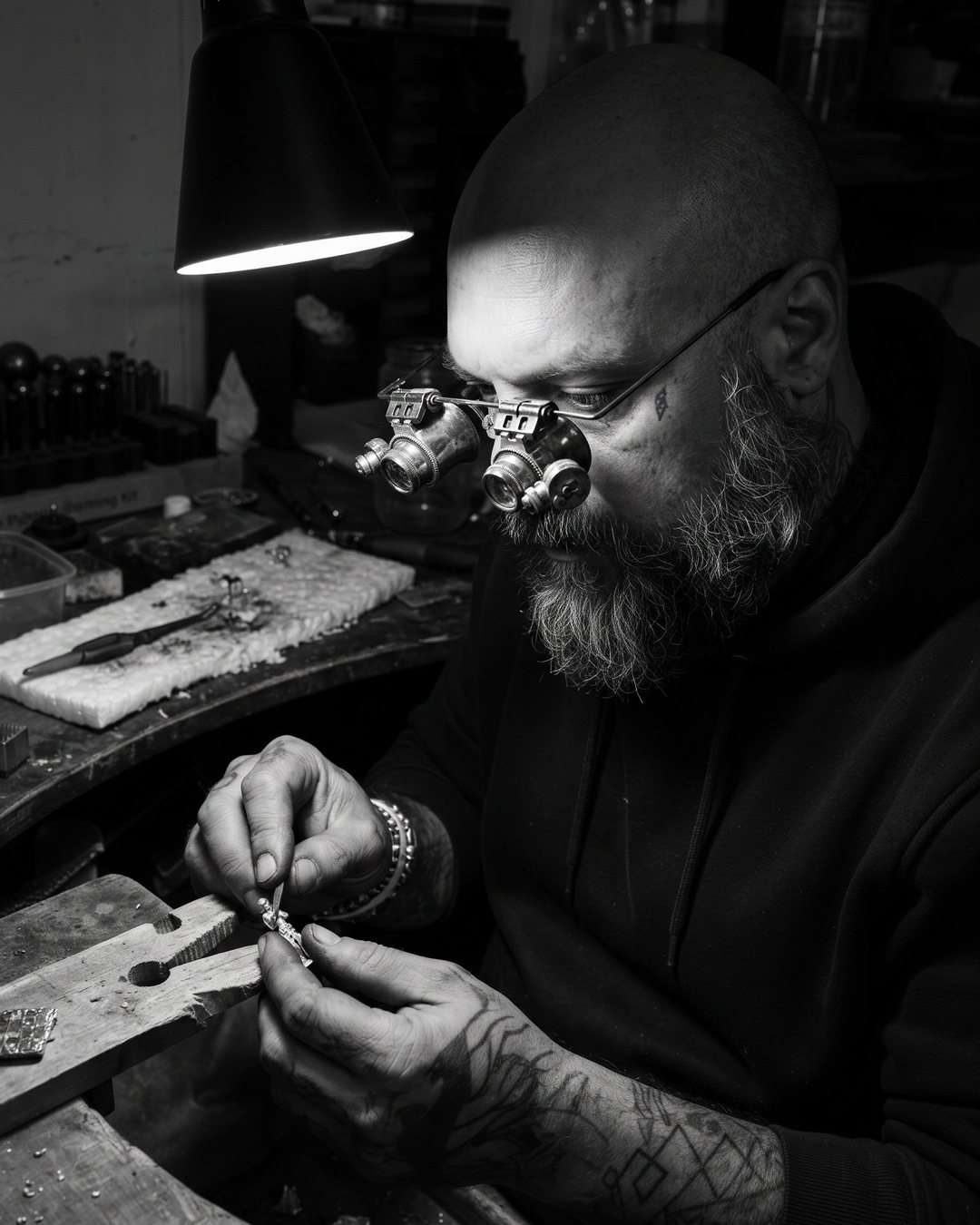
. Most jewellers work with magnification fixed to the head: lenses on a headband, a loupe clipped to glasses, or the double magnifiers you see in the photograph . They leave both hands free . A loupe held in the hand is for checking; a magnifier on the face is for working . With it, the distance between the eye and the piece becomes very short and very fixed . Move your head a few centimetres and everything goes out of focus . You learn to keep still in a way the rest of the body does not know .
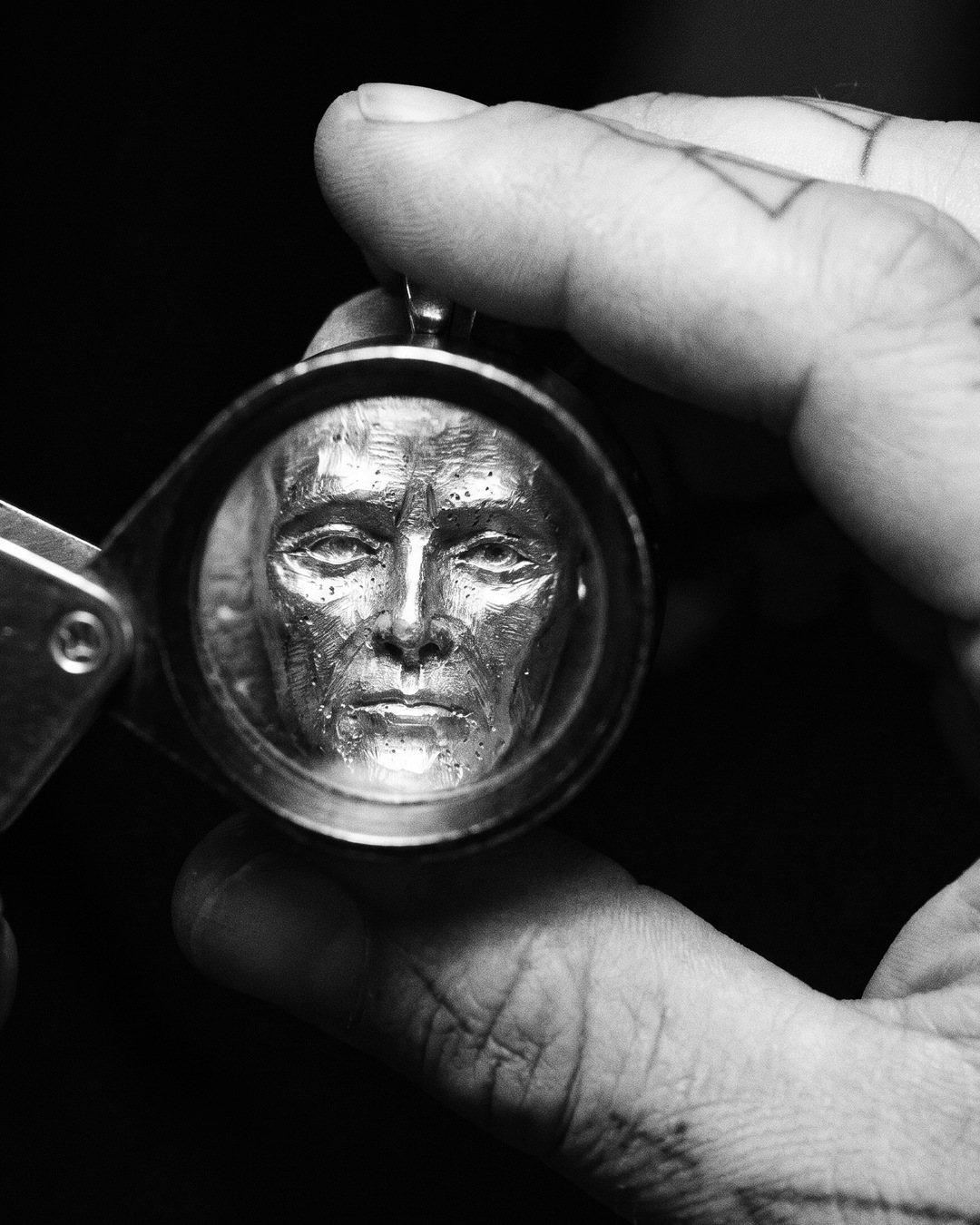
. Under the lens the piece changes nature . A surface that looked smooth becomes a landscape of ridges and valleys . A line that looked straight shows its small hesitations . A face shows where the file slipped, where the edge is too sharp, where the light catches wrong . Magnification does not make the work easier . It makes it honest .
A face under the glass becomes a landscape
Two distances
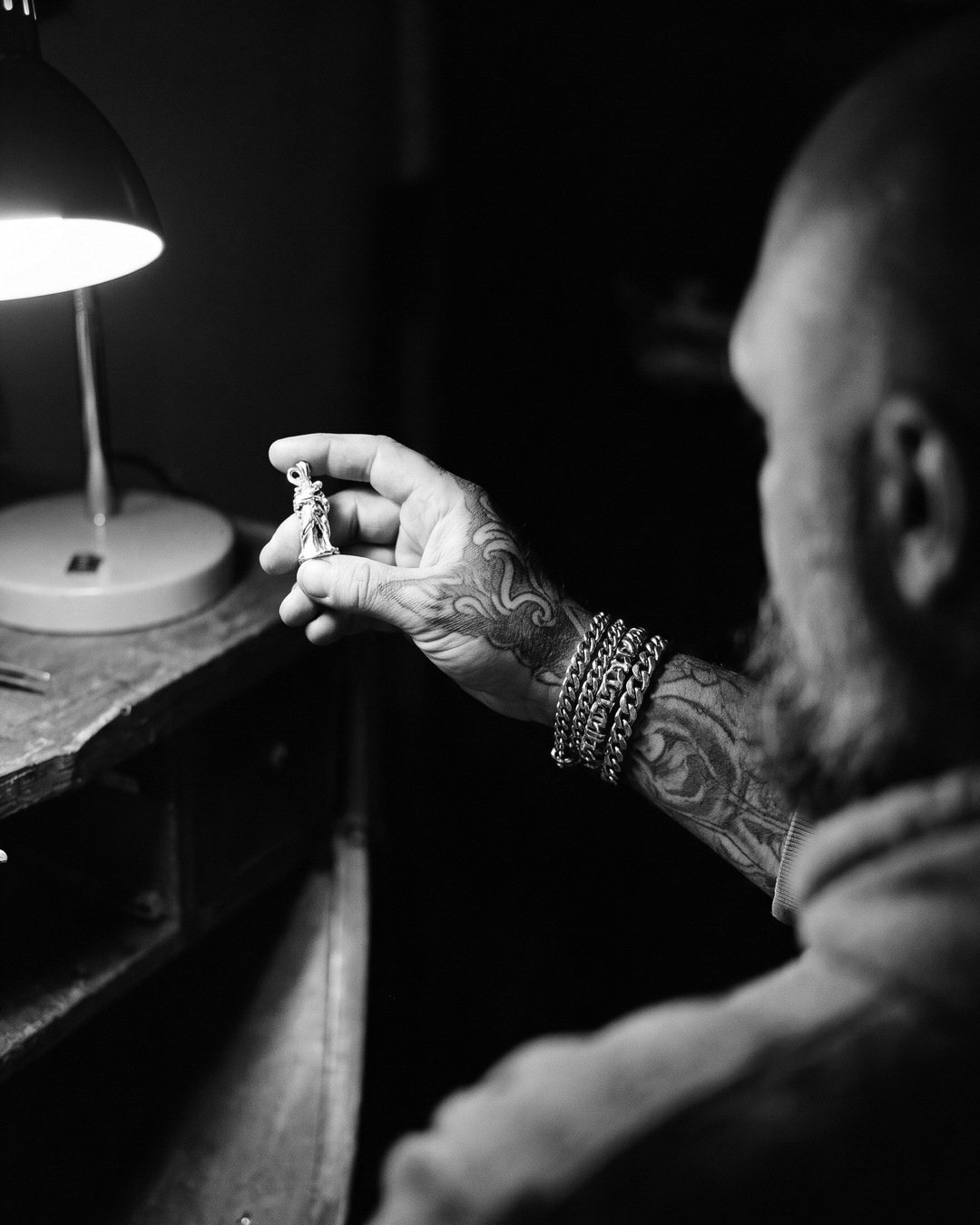
. The difficulty is that nobody will ever look at the piece that closely . It will be seen at arm's length, on a body, in passing light . So the work happens at two distances at once: close, to shape the detail, and far, to see if the detail is right . The lenses go up, the piece is held at the end of the arm, turned slowly under the lamp; then the lenses go down again . This back and forth, repeated hundreds of times, is most of what a day at the bench looks like .
The second distance: the piece held at arm's lengthClose enough to see the tool. Far enough to see the person.
. It is also the reason why some details are left rough on purpose . Under the lens, every mark looks like a mistake . At arm's length, the same marks are what make silver look alive . Knowing which ones to keep is not a technical skill . It is taste, and it takes years .
. The photograph shows exactly that moment: the lenses down, the figure between the fingers, the breath held . A few seconds later the head will lift, the piece will be held away, and the question will be asked again — is it right yet?