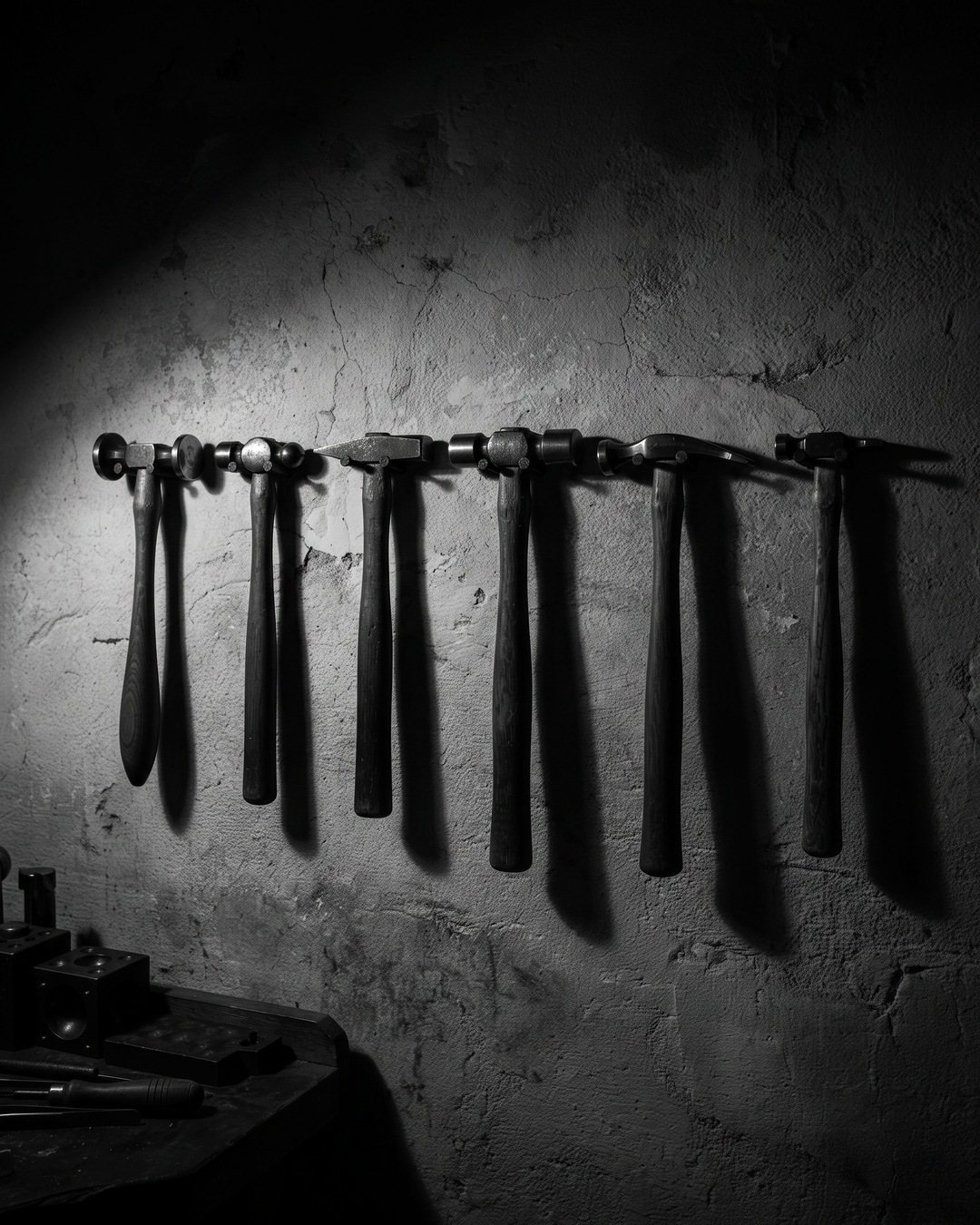
. On the wall of every jeweller's workshop hangs a row of hammers, and no two are alike . To a visitor they look like a collection . To the person who works there, each one is a different voice .
Journal 16 · Atelier
. On the wall of every jeweller's workshop hangs a row of hammers, and no two are alike . To a visitor they look like a collection . To the person who works there, each one is a different voice .
. Some hammers have broad, flat, mirror-polished faces . They are used to smooth and harden a surface, leaving it bright and gently faceted . Their faces are cared for like lenses: one scratch on the hammer becomes a scratch on every piece it touches . Others have a rounded face on one side, used to stretch and dome the metal, pushing it outward from the inside .
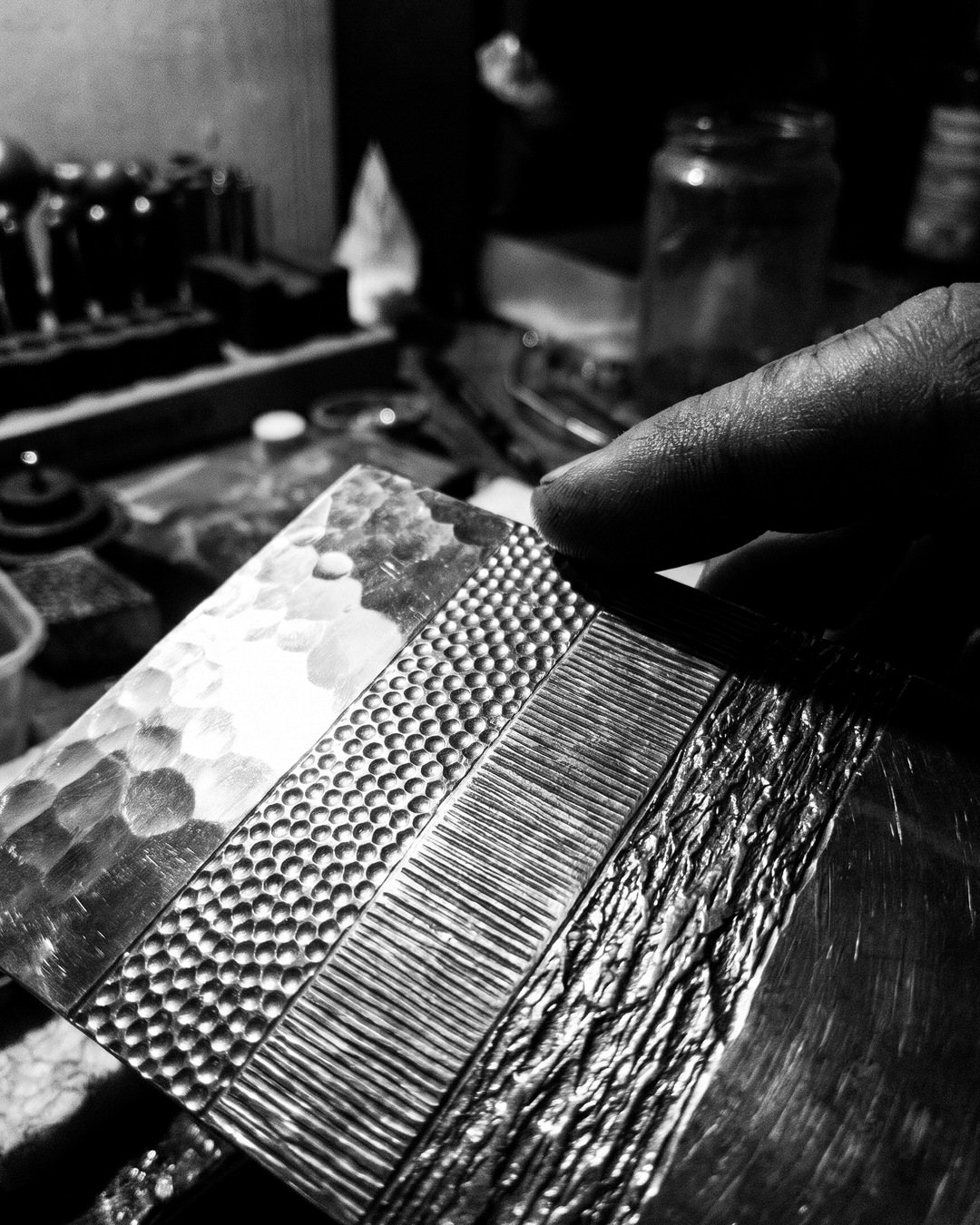
. There are small, light hammers for delicate work, made to tap rather than strike, and heavier ones for forging thicker silver . Some have a narrow wedge on the back to spread metal in one direction only . Some have faces cut with lines or dots, so that each blow leaves a texture — a way of drawing with impact instead of a pencil .
. Next to the steel hang hammers that do not look like hammers at all: heads of rawhide, wood, nylon or rubber . They are used when the metal must be moved without being marked — to straighten a wire, to round a ring without flattening its texture, to correct a shape gently . They are the quiet members of the family .
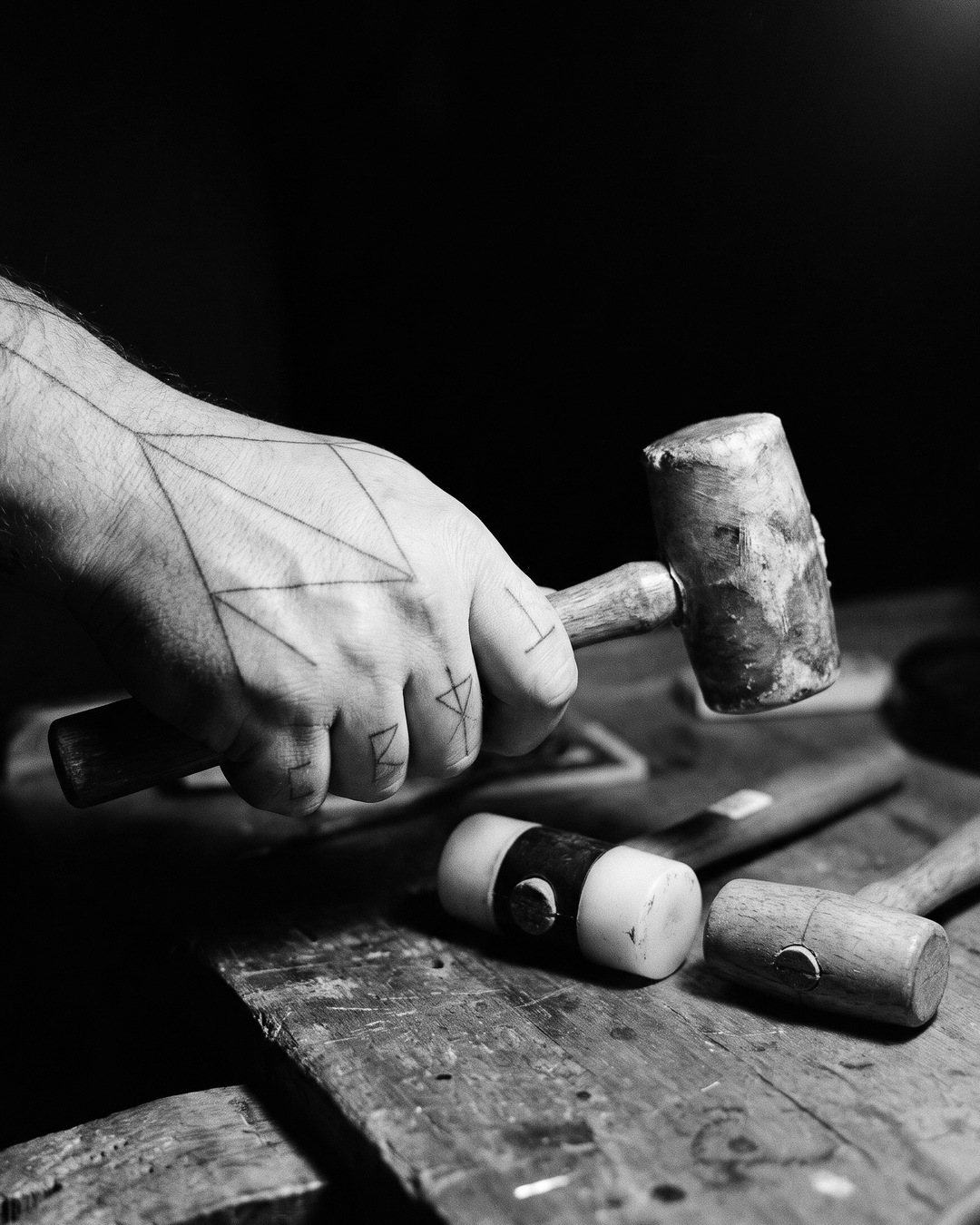
. The hardest thing about a hammer is not hitting where you aim . It is knowing how hard to hit . A blow that is too strong thins the metal, cracks it or leaves a mark that cannot be taken back . A blow that is too weak does nothing but tire the arm . Most good hammering is surprisingly light: many small, even blows instead of a few heavy ones, the wrist doing most of the work, the hammer allowed to fall more than it is driven .
. Over years, certain hammers become favourites . Their handles darken where the hand holds them; their faces carry tiny marks of old mistakes . They are rarely replaced . In many workshops, the oldest hammers on the wall belonged to someone else before .