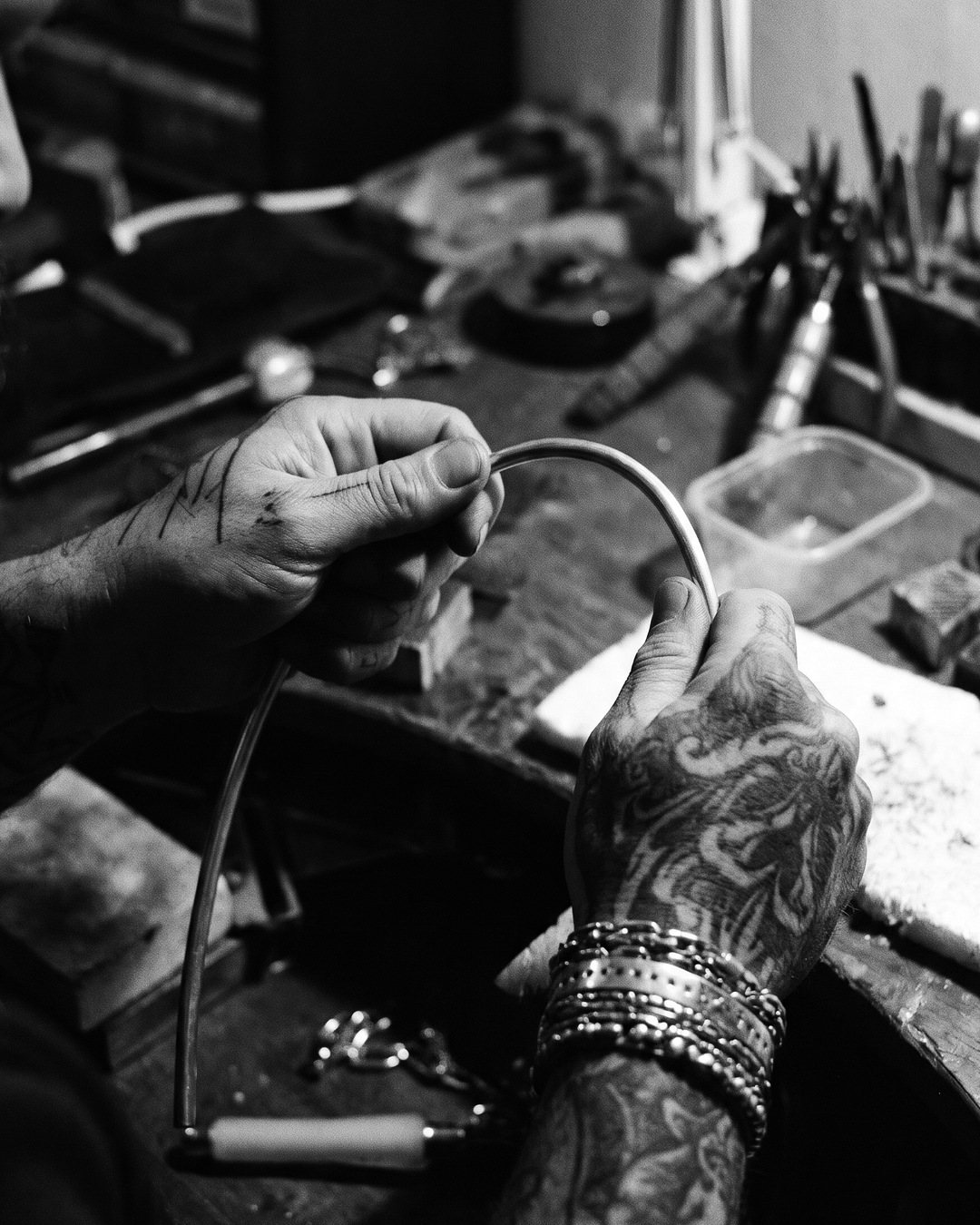
. Much of what we make starts as wire: a thin line of silver that will become a ring, a loop, the arm of a figure, the frame of a small chair . Wire is honest material . It shows immediately whether it is soft or tired .
Journal 14 · Atelier
. Much of what we make starts as wire: a thin line of silver that will become a ring, a loop, the arm of a figure, the frame of a small chair . Wire is honest material . It shows immediately whether it is soft or tired .
. Every time silver is bent, twisted, drawn or hammered, its crystals are pushed together and the metal grows harder . A soft wire becomes springy, then stiff, then brittle . Bend it too often without rest and it snaps in the hand . This hardening is useful — a finished ring should be firm, not floppy — but during the work it has to be reversed again and again .
. The flame does that . Heated until it glows a dull red and then allowed to cool, the wire relaxes . Its inner structure is reorganised, and it becomes soft enough to bend once more . Jewellers call this annealing, and on some pieces it is done a dozen times before the form is reached .
. The photograph shows that exact moment: the wire glowing, the flame wrapped around it . A few seconds more and the colour would turn orange, then bright, and the surface would begin to suffer . A few seconds less and nothing would change . The whole skill is in those seconds, and they cannot be measured with a clock . They are measured with the eye .
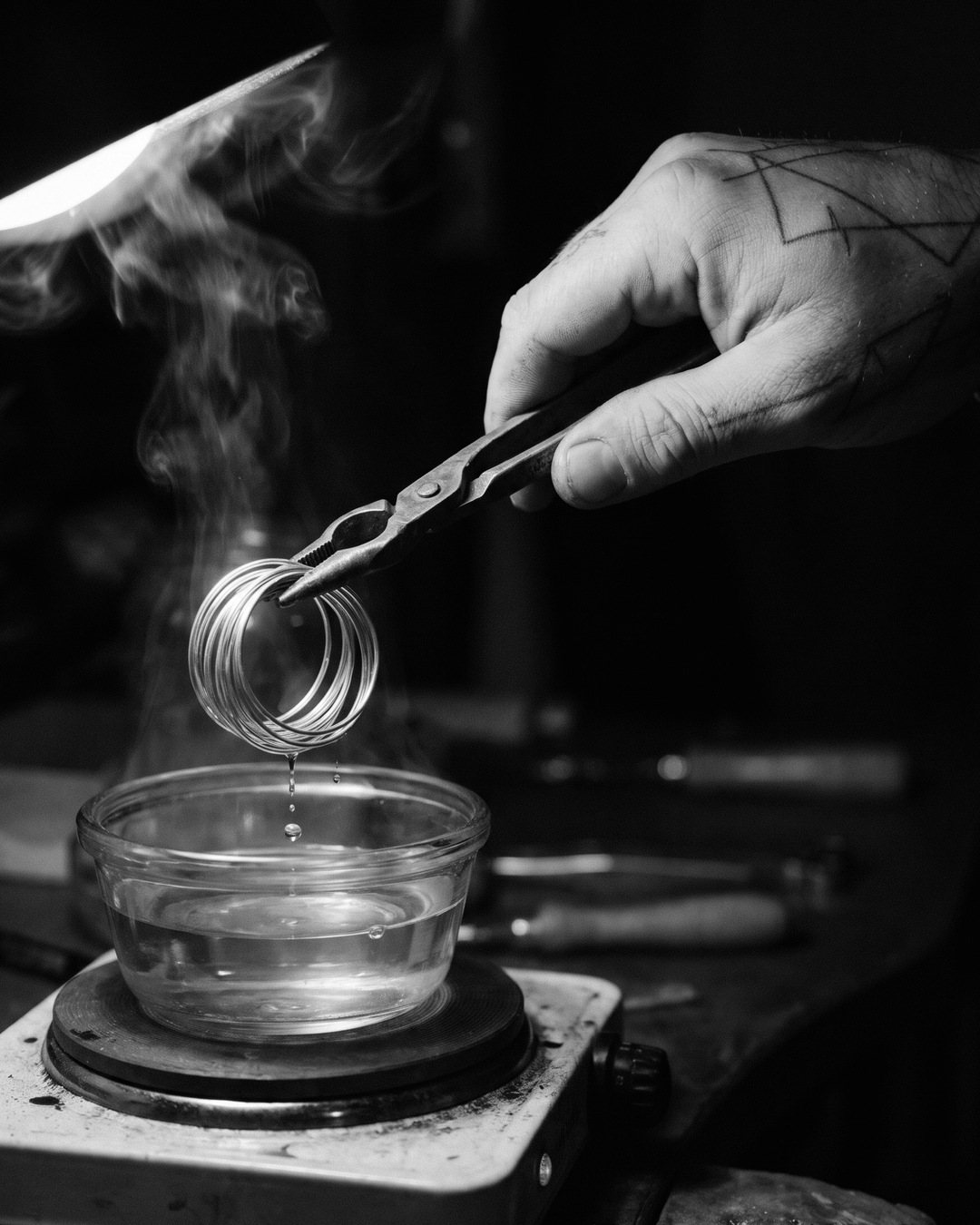
. After the heat comes the cool . Some jewellers let the wire rest until the glow disappears; others quench it in water . Then the surface, darkened by the fire, is cleaned, and the wire is ready to be worked again .
. Inside the wire, softening is a reorganisation of crystals . Bending and drawing crush them into long, stressed shapes; heat lets them grow back into calm, rounded grains . That is why a quick plunge into water after the glow keeps the wire soft: the copper in the alloy has no time to gather and stiffen the metal again . Left to cool slowly, sterling can end up harder and less predictable than expected .
. After every heating the wire comes out dark, coated with oxides . It goes into a warm, mild acid — a solution of sodium bisulfate, around 55–60 °C — which dissolves the dark skin in a few minutes and returns the silver to a pale, matte white . Only then can the next bend begin .
. A line of wire is the closest thing in silver to a line drawn with a pencil . Bent by hand, it never makes a perfect curve: it hesitates, straightens, turns a little more than planned . That hesitation is what we want to keep . In a chair made of wire, the legs are not identical . In a ring made of wire, the circle is not perfect . They look drawn, not printed — which is exactly what they are .