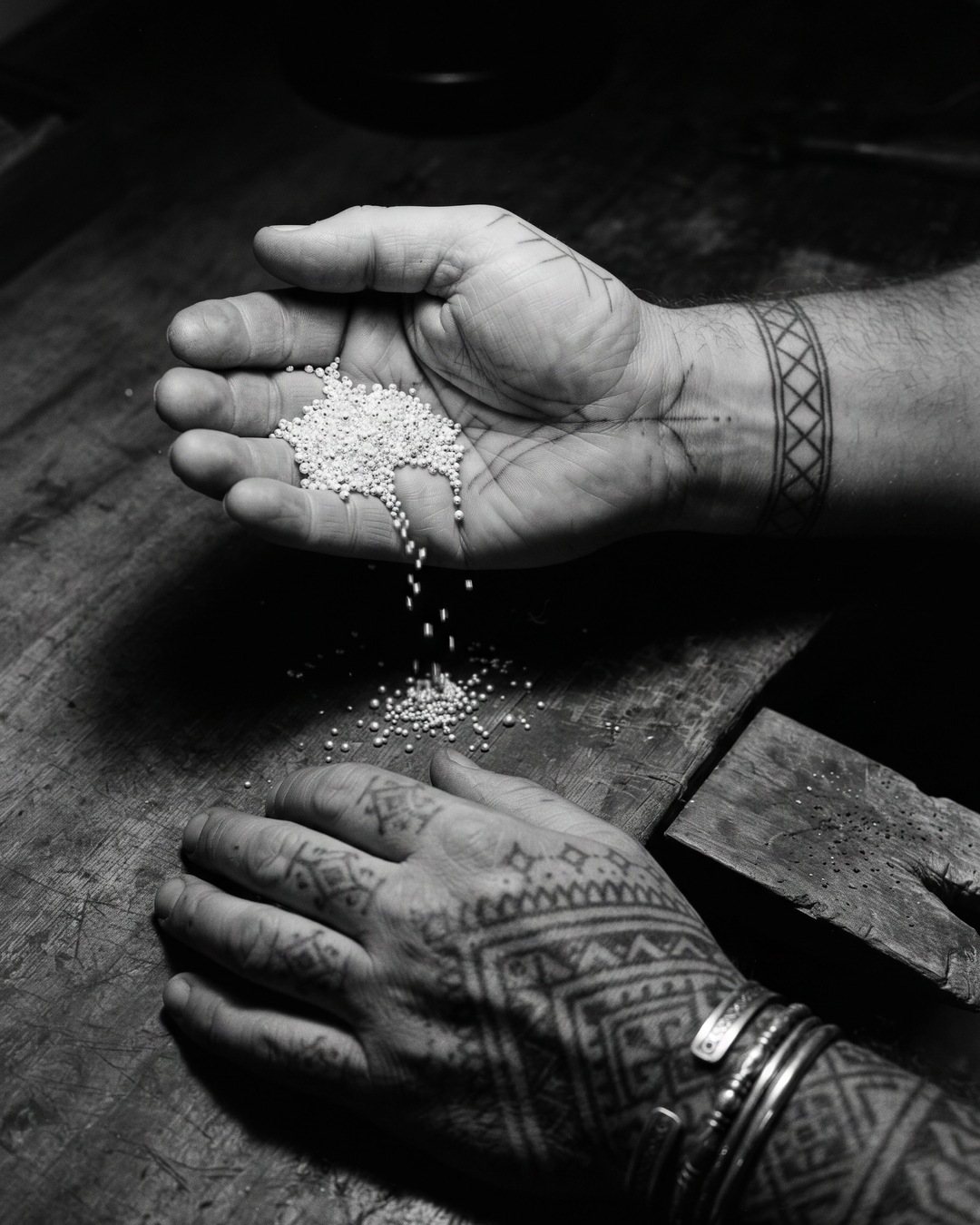
. Every piece we make carries a small number: 925 . It is not a serial number or a date . It is a measure of truth . It says that out of every thousand parts of the metal, nine hundred and twenty-five are pure silver .
Journal 03 · Material
. Every piece we make carries a small number: 925 . It is not a serial number or a date . It is a measure of truth . It says that out of every thousand parts of the metal, nine hundred and twenty-five are pure silver .
. Pure silver — 999 — is beautiful and almost useless for jewellery . It is so soft that a ring would lose its shape on the finger and a pendant would scratch at the first touch . For centuries silversmiths solved this the same way: by adding a little copper . Seven and a half parts in a hundred are enough to give silver backbone without taking away its colour . That alloy has a name older than most countries: sterling .
. Other standards exist, and each carries its own history . Britannia silver, 958, was once compulsory in England . Much old European silver is 800 or 835; Scandinavian pieces are often 830; coins were frequently 900 . We work only in 925, because it is the balance we believe in: hard enough to live on a body for decades, soft enough to keep every mark of the hand .
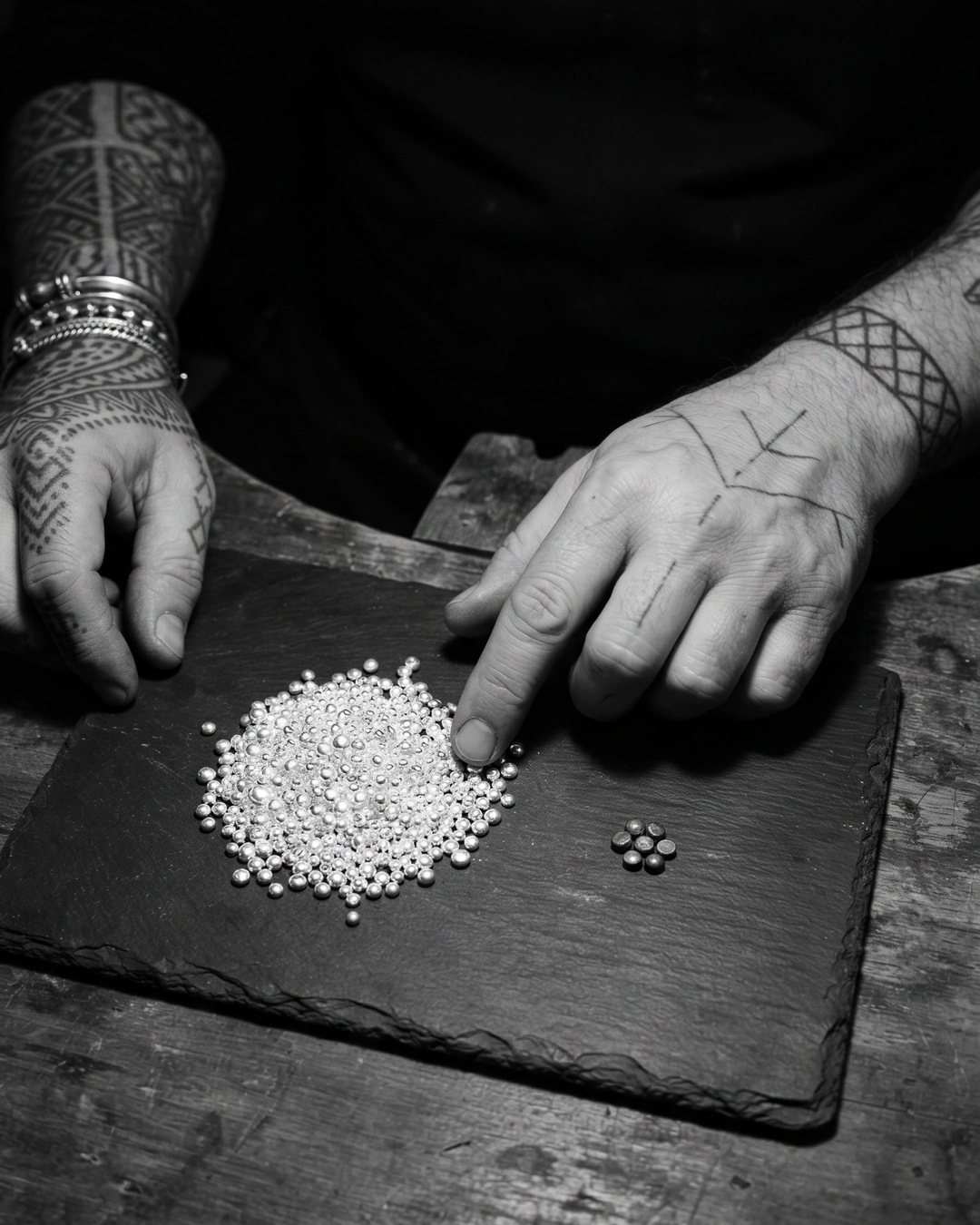
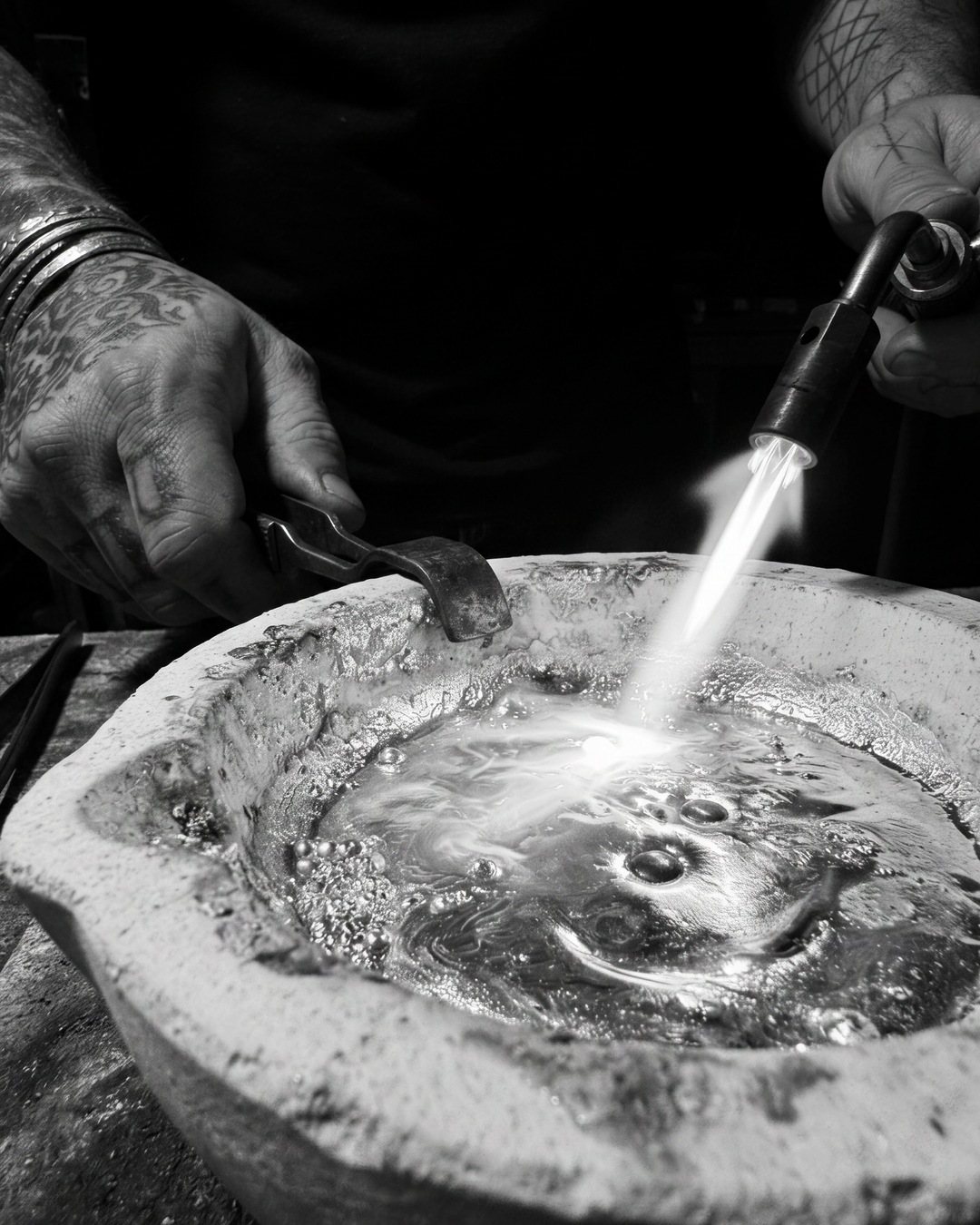
. Pure silver melts at one exact point, 961.8 °C . Sterling does not . Because it is a mixture, it melts across a range: it begins to soften and sweat at around 802 °C and becomes completely liquid only near 893 °C . Between those two temperatures the metal is neither solid nor liquid . Working with fire means knowing that zone well, because a thin part of a figure can slip into it while the thicker body is still safe .
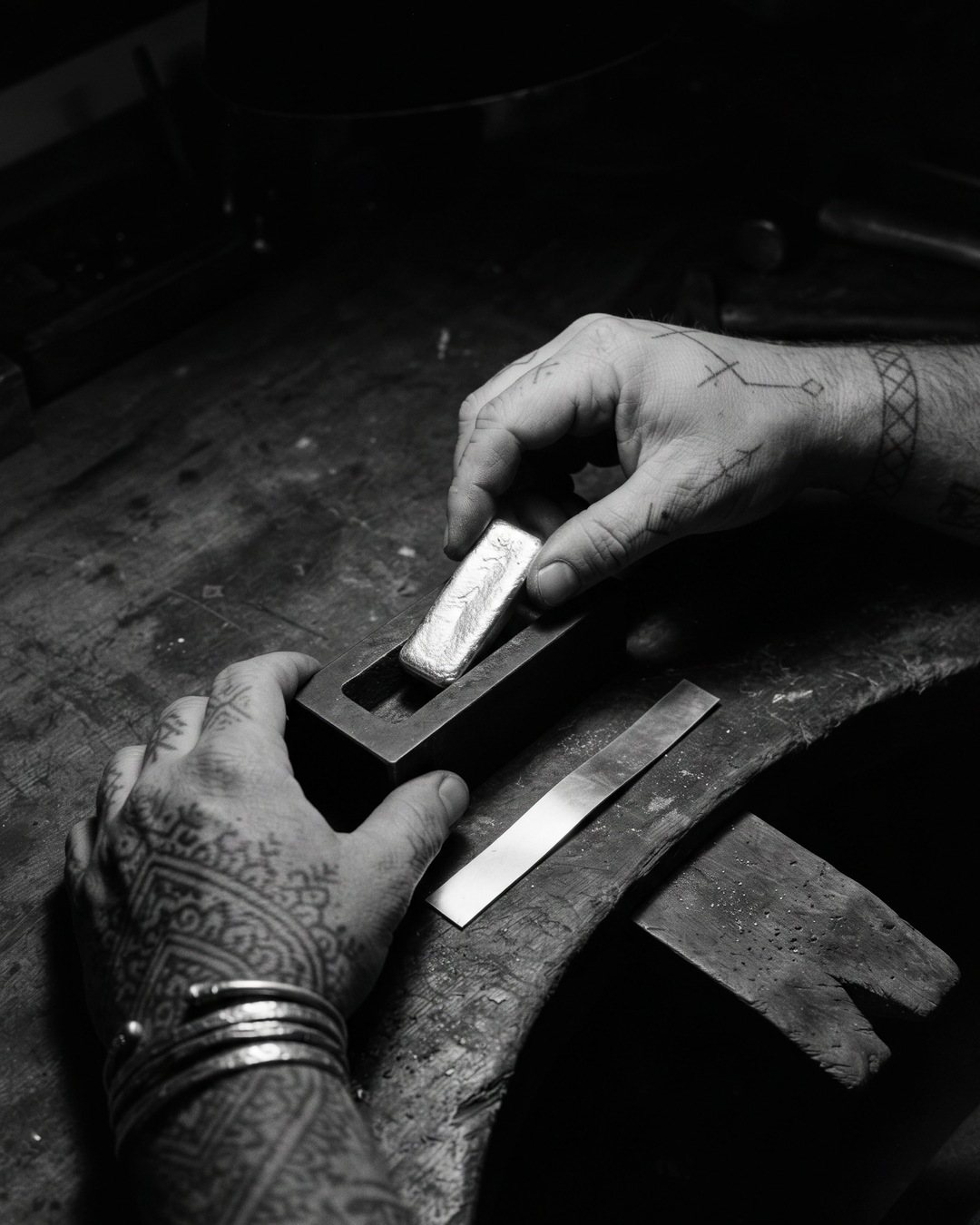
. Silver changes its character with what you do to it . Freshly softened, sterling is gentle — about 60 on the hardness scale . Every blow of a hammer, every bend, every pass of a rolling mill packs its crystals tighter; worked hard, it can triple in hardness and become springy, then brittle . Fire undoes this: heated to a dull pink glow, around 650 °C, and quickly plunged into water, the metal relaxes and becomes soft again .
. There is another, slower way to harden it, almost like aging . The silver is heated high, near 750 °C, plunged into water, and then held for an hour at a modest 300 °C . In that hour, invisible particles of copper gather inside the structure and lock it . The metal comes out twice as hard as before . Rapid cold softens; patient warmth strengthens . It is hard not to see something human in that .
. The copper that gives silver its strength also gives it a weakness . In the flame, oxygen slips beneath the surface and darkens the copper into a stain that no acid will remove: firescale, a faint purple shadow inside the metal . Jewellers protect against it with gentle flames, flux and charcoal, or bring a thin skin of almost pure silver to the surface by heating and pickling again and again . Copper is also why silver darkens with time — and why we choose to darken it ourselves .
. 925 is therefore not only a standard . It is a compromise between purity and life, between the ideal metal and the one that can actually be worn . Every piece we make lives inside that compromise . So do the people who wear them .