. An atelier looks chaotic to a visitor and perfectly ordered to the person who works in it . The order is not visual . It is physical: everything is placed according to how often the hand needs it and how quickly it must be found .
The three circles
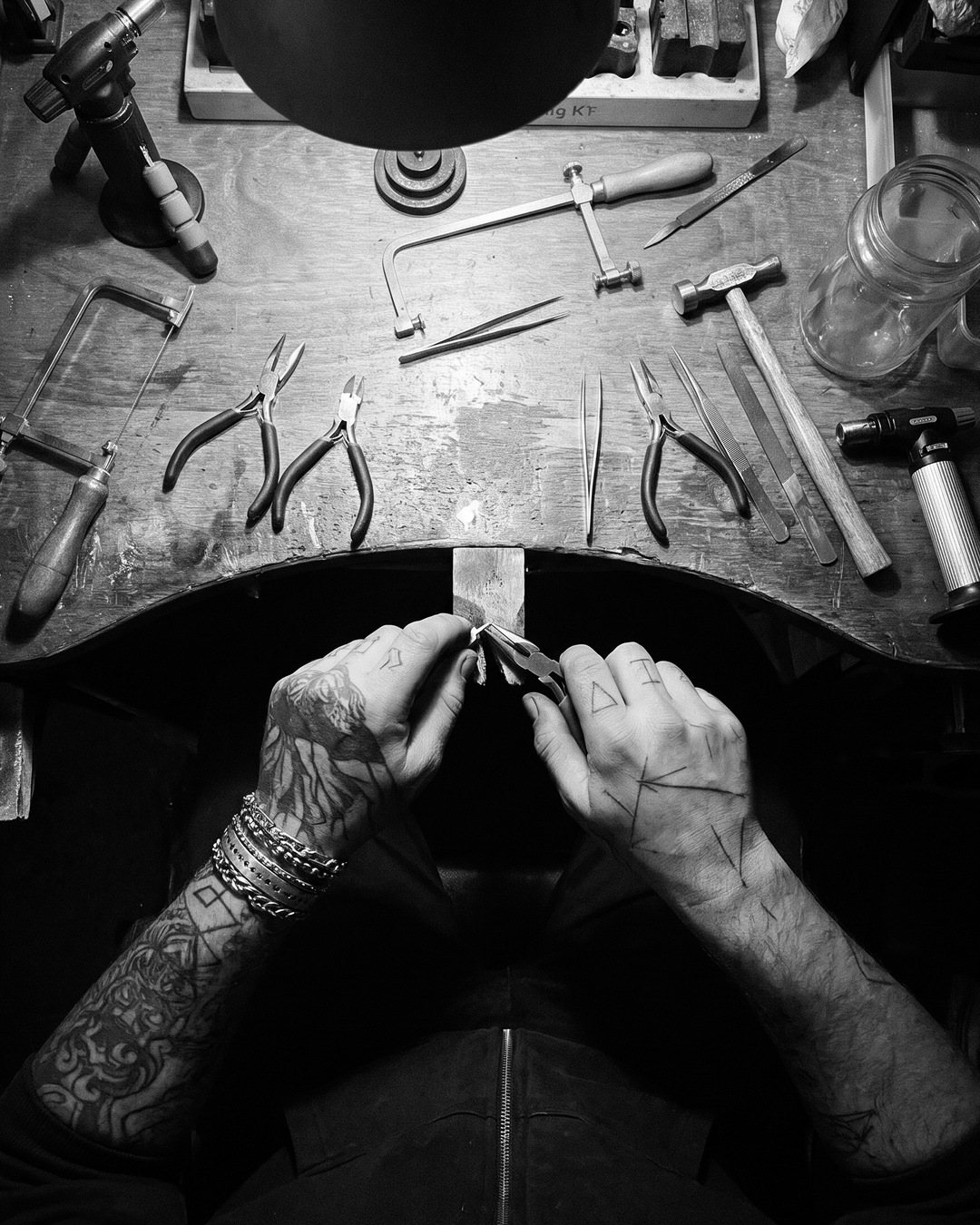
. Think of the bench as the centre of three circles . In the first, within the reach of the forearm without moving the shoulders, lie the tools used every minute: the files of the day, the tweezers, a pair of pliers, the lens, the torch . They are never put away . They are put down, always in the same place, so that the hand finds them while the eyes stay on the work .
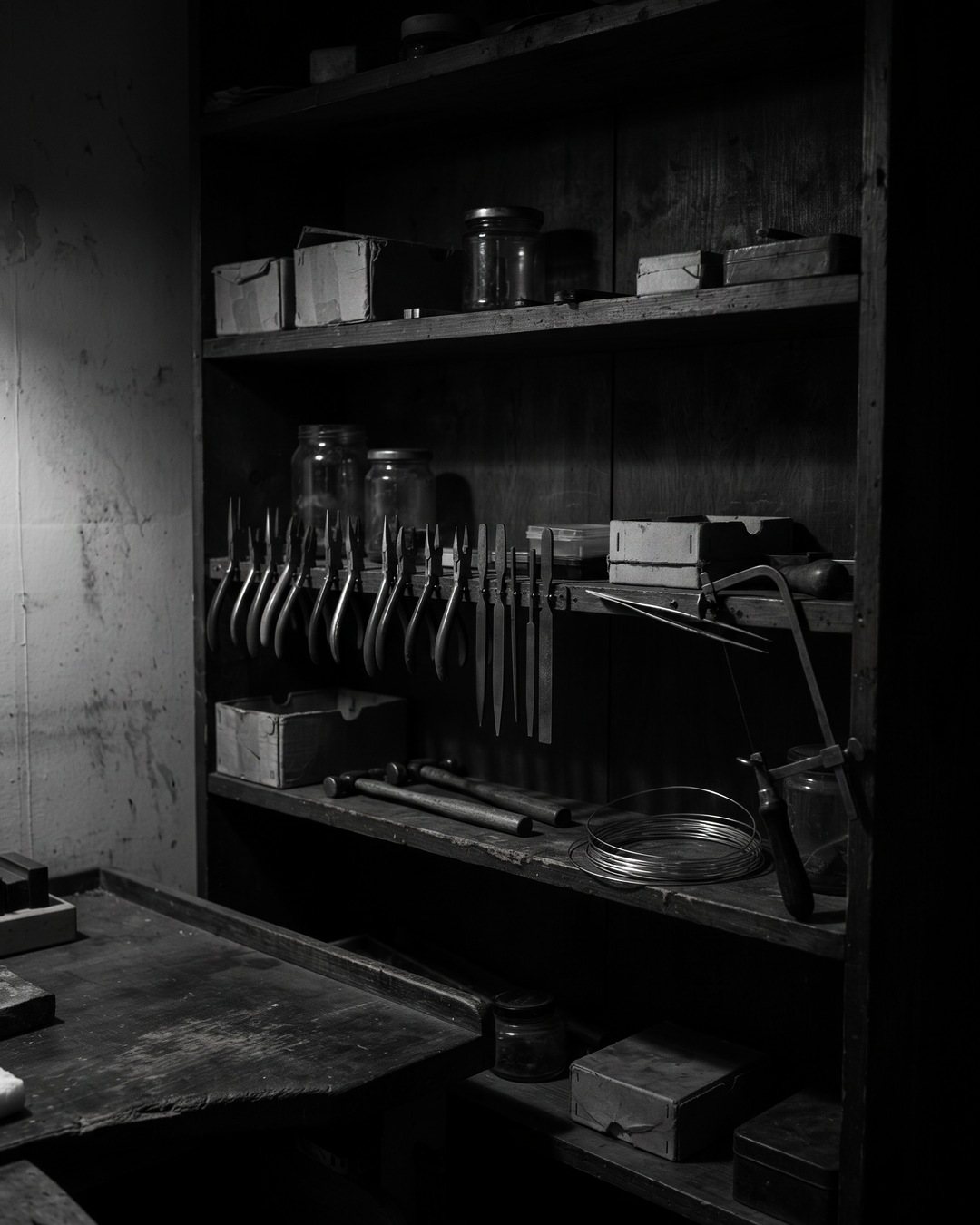
. In the second circle, within reach of the arm, are the tools used every hour: more pliers, punches, mandrels for rings, a small hammer, the steel block . In the third — the shelves behind, as in the photograph — wait the things used every day or every week: boxes of wire and sheet, jars of liquids, rarely used pliers hanging in a row, spare files, the tools that are needed only for certain pieces .
The bench from above: the circles of the tools
Why it matters
. Many moments at the bench are short . The metal is hot for a few seconds; a figure must be held in one exact position; a small part must be placed before the hand that holds the piece gets tired . When a tool is not where the hand expects it, that moment is lost . Losing it once is nothing . Losing it a hundred times a day is the difference between a piece that flows and a piece that fights you .
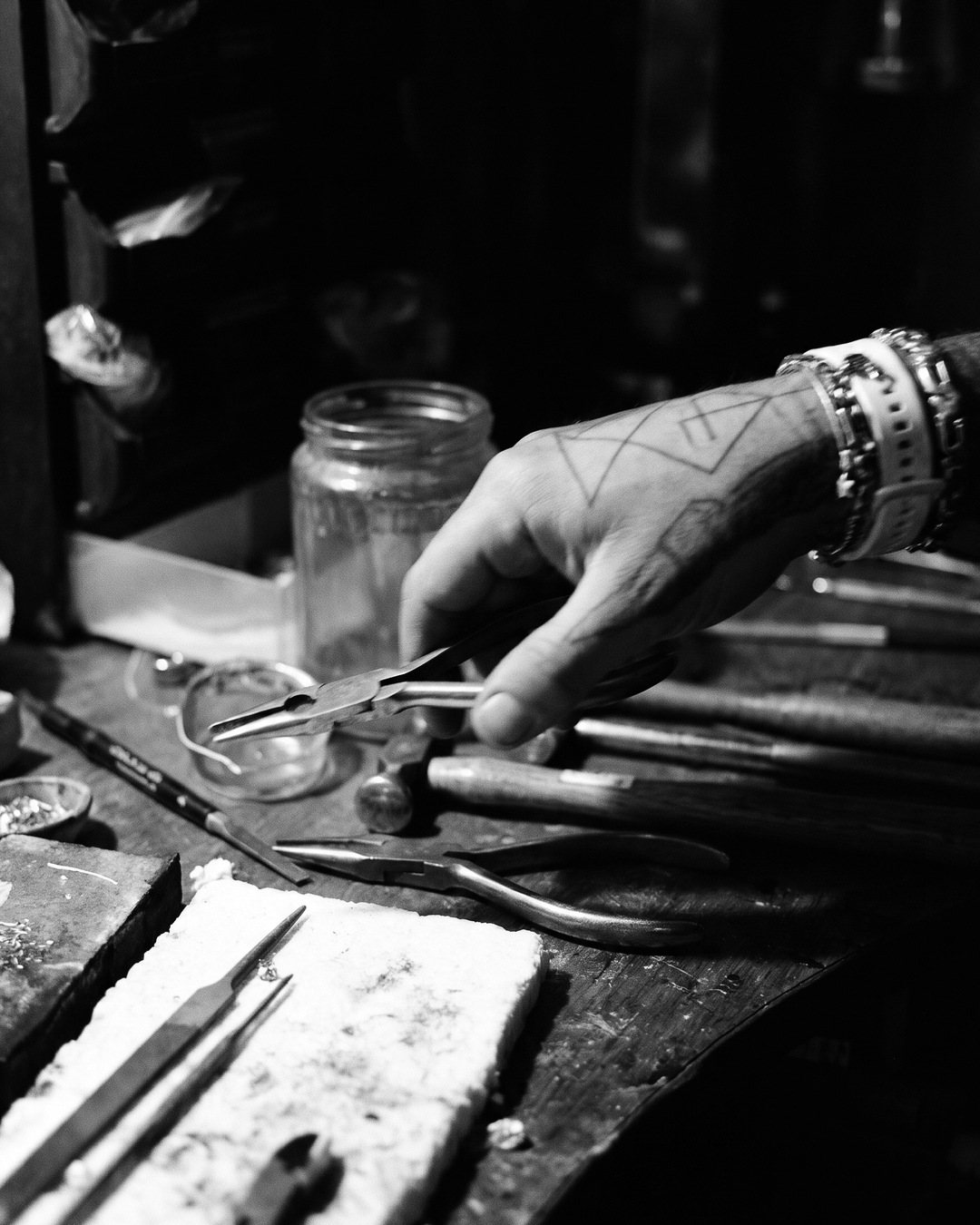
The hand finds the pliers without looking
. This is also why jewellers rarely like other people tidying their benches . To an outsider, a file lying across a pair of pliers is mess . To the person who left it there, it is a bookmark: it says where the last gesture ended and the next one begins .
Order is not how a room looks. It is how fast the hand finds what it needs.
The shelf
. The shelf in the photograph holds rows of pliers with handles hanging down, coils of silver wire, small boxes and jars . Each pair of pliers has its own job: flat jaws to grip without marking, round ones to bend curves, others to cut, to hold, to twist . Seen together, they look like instruments in an orchestra pit before a performance . Each one silent, each one waiting for the moment it will be needed .
. Over years an atelier becomes a portrait of the person who works in it . The worn spots on the floor, the tools that are always within reach and the ones gathering dust say more about how the work is done than any description could .